
Graduates of the Kamal-ol-Molk School and His Legacy
Kamal-ol-Molk, besides creating numerous artworks, was deeply involved in teaching painting. Since the founding of the Kamal-ol-Molk Art School, he welcomed students with boundless enthusiasm and exceptional kindness, imparting his knowledge to those who came to study under him. In 1928 (1307 SH), due to various reasons, he retired from his cultural services and settled in Hoseinabad, Nishapur, where he lived until his death in 1940 (1319 SH).
The Kamal-ol-Molk School left a lasting impact on Iranian art not only through the personality and works of its master but also by educating a generation of artists. In the book The Kamal-ol-Molk School by Mohajer and Hamedi, numerous pupils are listed who propagated their master’s teachings across various cities and played a significant role in continuing the tradition of realism in Iran. However, many details about the lives and artistic activities of these painters remain unclear or incomplete.
Among the many students who emerged from this school, several became teachers themselves and helped disseminate Kamal-ol-Molk’s artistic approach. Notable names—either direct or indirect students—include Hossein Ali Khan Vaziri, Esmail Ashtiani, Ali Mohammad Heidarian, Mahmoud Olya, Ali Akbar Yasemi, Ne’matollah Moshiri, Mohsen Soheili, Ali Rokhsaz, Hossein Sheikh Ehyā, Shahabi, Rafiee Halati, Eskandar Mostaghni, Ali Akbar Najm Abadi, Abolhassan Sedighi, Shokat ol Molouk Shaqaqi, Mohsen Moghadam, and Mostafa Najmi. Many of these artists achieved high artistic ranks and produced significant works.
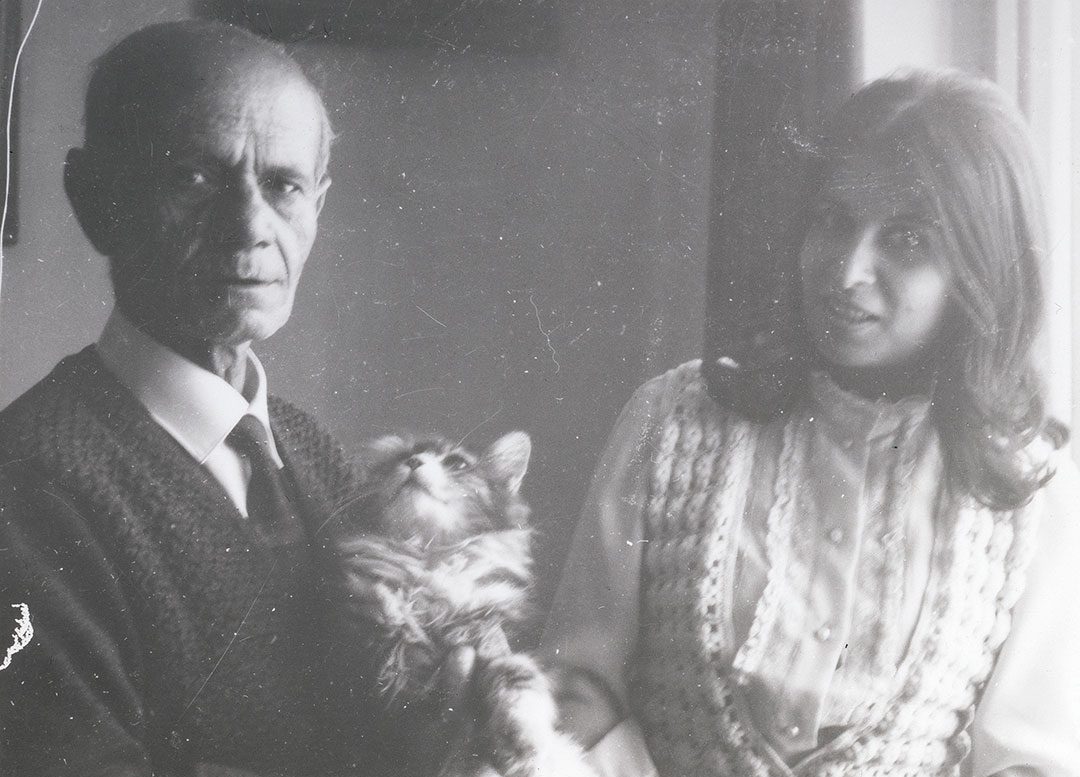
Among these distinguished pupils is Noor Mohammad Mir Amadi, recognized as a student aligned with Kamal-ol-Molk’s school. The Kamal-ol-Molk School and its teaching methods influenced many artists, and Mir Amadi was among those who continued the realism and naturalism of his master. Mir Amadi was also the direct instructor of Mehri Akbari.
Life and Artistic Evolution of Kamal-ol-Molk: From Court Painter to Artistic Independence
Kamal-ol-Molk, born Mohammad Ghaffari, is undoubtedly one of the most important and influential figures in the history of contemporary Iranian painting. He is considered a pivotal figure in the transition of Iranian painting from the ancient tradition of miniature painting to a new, realistic approach. The school he founded dominated Iranian art for approximately seventy years and is recognized as the pioneer of modernism in Iranian painting. Through Kamal-ol-Molk, modernism entered Iranian painting, transforming the language and themes of traditional painting.
The Qajar era, especially the Constitutional Revolution, provided fertile ground for deep cultural and social transformations, including in the arts. Painting began to abandon traditional rules and moved toward objective representation and depiction of reality. Kamal-ol-Molk was the leading painter of this period and the founder of a new style that set aside symbolic and unrealistic Persian painting, instead focusing on portraying external realities.
Kamal-ol-Molk’s artistic life mirrors the social and artistic changes of his time. Born in 1847 (1226 SH) into the Ghaffari family of Kashan, he began his education at Dar al-Fonoon (the polytechnic school), under prominent teachers including Ali Akbar Khan Mozayyen-ol-Dowleh, his uncle and mentor. Dar al-Fonoon, which at the time was mainly accessible to nobility, provided him with opportunities for academic learning and painting education. Mozayyen-ol-Dowleh, having studied painting in France, was instrumental in teaching Kamal-ol-Molk the realist style.
The Period as Court Painter under Naser al-Din Shah
After years of training and demonstrating exceptional talent, Mohammad Ghaffari was summoned to the court of Naser al-Din Shah, where he was appointed as the court painter (Naqqash Bashi) and the Shah’s special attendant. This period (circa 1878 to 1895; 1297 to 1314 AH) marks Kamal-ol-Molk’s first professional phase, where his artistic work was conducted under direct royal supervision near the centers of power. He gained the Shah’s respect and numerous rewards. Works from this period primarily include royal portraits, natural landscapes such as governmental camps in Sorkheh Hesar, Naseri Mansion, and paintings of court buildings like the Sahebqeraniyah Bathhouse and the Mirror Hall.
These works exhibit Kamal-ol-Molk’s outstanding technical skill. He compensated for the imposed themes through meticulous and refined execution. For example, the painting The Mirror Hall (1313 AH) is among the most labor-intensive works of this period, where despite the compulsory subject, Kamal-ol-Molk dedicated years to create it with great precision. This indicates that during this era, technical mastery was the solution for artists facing autocratic imposition of subjects. Toward the end of this period, he distanced himself slightly from court themes and chose freer subjects such as The Soothsayer (1309 AH) and The Egyptian Man (1304 AH), portraying ordinary people’s lives.
The Kamal-ol-Molk School: Characteristics, Approaches, and Influences
The core of the Kamal-ol-Molk School lies in its realist and naturalist approaches. Kamal-ol-Molk rejected the traditional miniature painting style, which did not portray the life of contemporary people, and engaged in precise, documentary representation of his time and the everyday people of streets and markets—a novel approach in Iranian painting. He separated painting from the handicrafts and artisanal traditions. His method emphasized exact and detailed reconstruction of nature, atmospheric effects on colors, and the descriptive and metaphorical use of light and color.
The Emergence of Oil Painting
Oil painting is a medium with a long and prestigious cultural history in global art. Many masterpieces that shaped art history have been created using this technique. This method, used for centuries, is favored for its versatility, brilliant color depth, and suitable consistency that allows correction and layering. Oil paint combines finely ground pigments with a drying oil such as linseed oil, enabling artists to express thoughts, emotions, and ideas through numerous techniques.
The earliest oil paintings date back to approximately the 7th century CE. The first recorded oil paintings were Buddhist murals in the Bamiyan caves of Afghanistan, where a primitive form of oil-based paint was used. These paints likely contained oils extracted from readily available sources like poppy seeds and walnuts. Recently, shields and other decorated weapons from the same period (circa 700 CE) have been discovered, showing a wide range of pigments and even final varnish layers, indicating that oil-based paint techniques were used in Asia centuries before being recognized in Europe.
In Europe, the earliest recorded oil paintings date to around the 11th century, mostly on wood panels prone to cracking and difficult preparation, producing less intense color. However, Theophilus Presbyter (c. 1125 CE), in his treatise De diversis artibus, described oil painting techniques, likely used for sculpture and woodwork decoration, especially outdoors.
Oil Painting in Europe and the Renaissance
Oil painting gained prominence in the 15th century when Jan van Eyck developed early oil painting methods and became a pioneer of the Northern Renaissance. The Renaissance marked a cultural “rebirth” in Europe, revisiting classical philosophy and transforming art and literature. Artists sought an alternative to egg tempera, discovering that oil paints offered richer colors and greater transparency, allowing deeper painting.
By mid-15th century, early Dutch painters like Jan van Eyck influenced many Italian and Northern European artists with works using tempera underpainting finished with oil layers. Hieronymus Bosch also advanced oil painting, particularly its slow drying, which gave painters more control and finer color blending.
By the 16th century, oil painting became the dominant medium. Artists such as Leonardo da Vinci created masterpieces like The Last Supper (1495–98) and Mona Lisa (1503–06), whose influence endures. The introduction of canvas replaced wooden panels, allowing freer painting styles. Titian exemplified this evolution. In the 17th century, masters like Diego Velázquez, Peter Paul Rubens, Rembrandt van Rijn, and Johannes Vermeer perfected oil techniques, with Vermeer noted for smooth gradients and nuanced color modeling.
Oil Painting in Modern Times
The invention of squeezable oil paint tubes by John Goffe Rand in 1841 facilitated plein air painting, significantly influencing movements like French Impressionism. Today, despite acrylics’ rise, oil remains a preferred medium globally due to its unique qualities.
Oil Painting in Iran: From Safavid to Qajar and Kamal-ol-Molk’s Role
Evidence shows oil painting was used in Iran before the Qajar era. The Safavid period (10th–11th century AH) was one of Iran’s most brilliant post-Islamic art eras, with expanding artistic centers and workshops. Mural paintings flourished, especially under Shah Abbas I, adorning grand palaces like Chehel Sotoun and Ali Qapu in Isfahan, and sites in Shiraz and Qazvin.
Flourishing of Oil Painting in the Qajar Era and Kamal-ol-Molk’s Emergence
In the late 18th and 19th centuries (Qajar period), a tradition of oil painting blossomed in Iran, producing some of the finest examples of the genre. Artists such as Mirza Baba, Sani al-Molk (Abolhasan Ghaffari Kashani), Mehr Ali, Abolhasan Naqqash Bashi Afshar, Mohammad Hasan Beyk Afshar Orumi, and ultimately Kamal-ol-Molk exemplify this development
Kamal-ol-Molk’s Role in Qajar Oil Painting
Kamal-ol-Molk’s works stand as some of the most outstanding of Qajar oil painting. His royal portraits, including those of Naser al-Din Shah seated in European-style armchairs wearing military uniforms—such as the similar works from 1889 and 1891—are exemplary of Qajar iconography. These paintings not only demonstrate Kamal-ol-Molk’s technical mastery in oil but also reflect aesthetic shifts from Eastern-Asian forms and styles to European-influenced academic painting during this period.